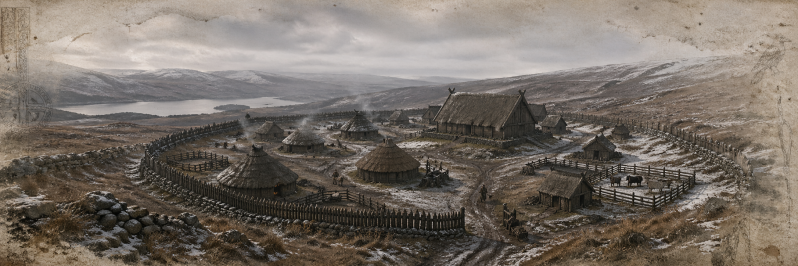
Beyond Winter's Silence is nearly finished. The first draft is complete, the retcon pass is underway, and publication is due in May. That is a practical fact. But it is also a moment worth pausing on, because the book that is almost ready did not begin with a plot. It began, as everything in this project begins, with a question about how a place actually works.
That is worth explaining.
Panimálay — the world in which Edrass sits — was not designed around a narrative. It was built the way a geographer or a historian might approach an unfamiliar region: from the ground up, through climate, terrain, and the pressures those things place on human life. What grows where, and why. Where water runs and where it fails. How people move through upland country in winter, and what that costs. How communities store food, defend it, and decide who has authority over it. These are not decorative questions. They are the questions that produce culture, law, hierarchy, and belief — slowly, under pressure, over generations.
Edrass is an upland region. That is not a backdrop choice. Upland life in the pre-modern world — and the series is set at approximately 200 CE, in a world whose material conditions are broadly those of Iron Age and early post-Roman Britain — is a specific set of constraints. Thinner soils. Shorter growing seasons. Harder winters. Distances that matter more because the terrain makes them matter. Settlement patterns shaped by where ground can be farmed and where stock can be run. Alliance systems shaped by the need to survive a bad year, which no single holding can do alone.
When you build from those constraints honestly, the culture that emerges is not invented. It is required.
Beyond Winter's Silence is, at its core, a book about a ward system being built. A small cluster of upland holdings, bound together by procedure, obligation, and shared interest in surviving the next winter and the one after that. To write that convincingly — to have it feel like something that grew rather than something installed — the system has to actually function. Not gesturally. Procedurally.
That means knowing how the renders work. How labour obligation is calculated and recorded. How a disputed claim gets heard, and by whom, and under what conditions the decision holds. How food stores are counted, allocated, and defended against both scarcity and the people who would take more than their share. How a man earns the right to speak in a hall and how he loses it. These are not questions the reader is ever asked to sit down and study. But they have to be answered before a word of the fiction is written, because the moment a character acts within a system that has not been properly built, the prose knows. It goes thin. The decisions stop having weight.
The real-world parallel is direct. The Anglo-Saxon administrative system — the hundred, the wapentake, the render obligations of the early medieval estate — did not appear fully formed. It accumulated, was tested, failed in places, was repaired, and hardened into procedure over time. The scholarship on how these systems actually worked — the food renders of *Rectitudines Singularum Personarum*, the boundary clauses of the charters, the witness lists that tell you who was in the room and therefore who had standing — is not background reading for the fiction. It is the structural model. Edrass is not Anglo-Saxon England. But the logic of how a protection economy functions, how obligation is recorded, how legitimacy is built through witness and procedure rather than through force alone — that logic is historical, and it has to be honoured in the fiction or the fiction does not work.
There is a structural device in Beyond Winter's Silence that goes to the heart of why the worldbuilding has to be done properly. The book opens and closes with a voice from the Orthodoxy Chronicle — a clerical record written a century and a half after the events it describes. The Chronicle is confident, institutional, and wrong in the way that official records are wrong. It credits Isenwynn with founding the ward, binding the holds, ending the hunger. It does not mention the people who built the system alongside him. It does not mention the cost. It does not mention the man whose death made the ward necessary, or the years of watching and procedure that preceded it.
This is not a fantasy conceit. It is how history works.
The Chronicle exists because power, in Edrass as in the real world, has an interest in how the past is recorded. The Orthodoxy — the institutional religious authority whose reach into Edrass grows across the series — benefits from a founding narrative that is clean, attributed to a single figure, and legible as the kind of order the Orthodoxy would recognise and endorse. The messy, collective, procedural reality of how the ward was actually built serves no one's institutional interest. So it does not appear in the record.
What the series is doing — what Beyond Winter's Silence does explicitly — is functioning as a corrective account. The gap between what the Chronicle says and what the book shows is the engine. It is also a reminder that the world has to be built properly precisely because the fiction's job is to show what the record omits. If the ward system is vague, the gap has no weight. If the procedure is real, the Chronicle's silence on it becomes meaningful.
The parallel again is historical. We know what we know about early medieval Britain partly through documents that were written to serve specific interests — land grants that establish ownership, saints' lives that establish sanctity, chronicles that establish legitimacy. The scholarship of the last fifty years has been substantially concerned with reading those documents against the grain: asking not just what they say but why they say it, who benefits, and what they are not saying. That critical habit is built into the structure of this series. Edrass has its own institutional history-makers, and they are not neutral.
Beyond Winter's Silence is a book about three years of upland life at approximately 200 CE, in a region built from the constraints that upland life actually imposes. It follows a ward system being assembled by people who have no guarantee it will hold, against a threat that moves carefully and does not announce itself. None of that is spectacular. All of it is consequential.
That is what the worldbuilding is for. Not atmosphere. Not flavour. Not the pleasure of invented terminology, though that has its place. The infrastructure exists so that the consequences are real — so that when a decision is made in a hall, or a border is crossed, or a man is put down in a garth, the weight of it is carried by something solid underneath. A world built properly makes the fiction's costs legible. That is the only reason to build it at all.
The third book, Ridge Wars, is already in structural development. The blood feud that Beyond Winter's Silence sets in motion will need a world capable of sustaining what comes next. That work continues.
Add comment
Comments